#newjust now
Anonymous Coward
Guest
Paul Laffoley's paintings look like control panels for the universe. Each is a large square canvas, packed edge to edge with hand-lettered text, diagrams, numbered stages and small inset images, and most end with a line of tribute that begins "Homage to." He made them for fifty years in a single room in Boston that he called the Boston Visionary Cell. He also said that one of them was designed with the help of an extraterrestrial, and that a metal implant in his brain was the main source of his ideas. For most of his life the art world did not know what to do with him. In his last decade it started to.
Laffoley was born in Cambridge, Massachusetts, on August 14, 1935. (Some sources, including the Outsider Art Fair and Raw Vision, give 1940, but his estate's biography gives 1935 and he was 80 when he died.) His father was a lawyer with an interest in occultism and Eastern religious practice, and Laffoley later said his father influenced him more than the church did. He was diagnosed with Asperger's syndrome as a child.
He studied classics and art history at Brown University, graduating in the early 1960s, and then went to the Harvard Graduate School of Design. He did not finish. By his own account he was "grand juried" out of Harvard for "conceptual deviance." The Outsider Art Fair says he was forced to withdraw; Raw Vision says he was dismissed for his unconventional ideas. Either way, he left.
In 1963 he moved to New York to work as an assistant to Frederick Kiesler, the Austrian-American architect and designer of the visionary "Endless House." He is also said to have been hired to watch late-night television for Andy Warhol in exchange for a place to live. He later studied at MIT's School of Architecture and the Boston Architectural Center, and in 1999 he was licensed as an architect in Massachusetts.
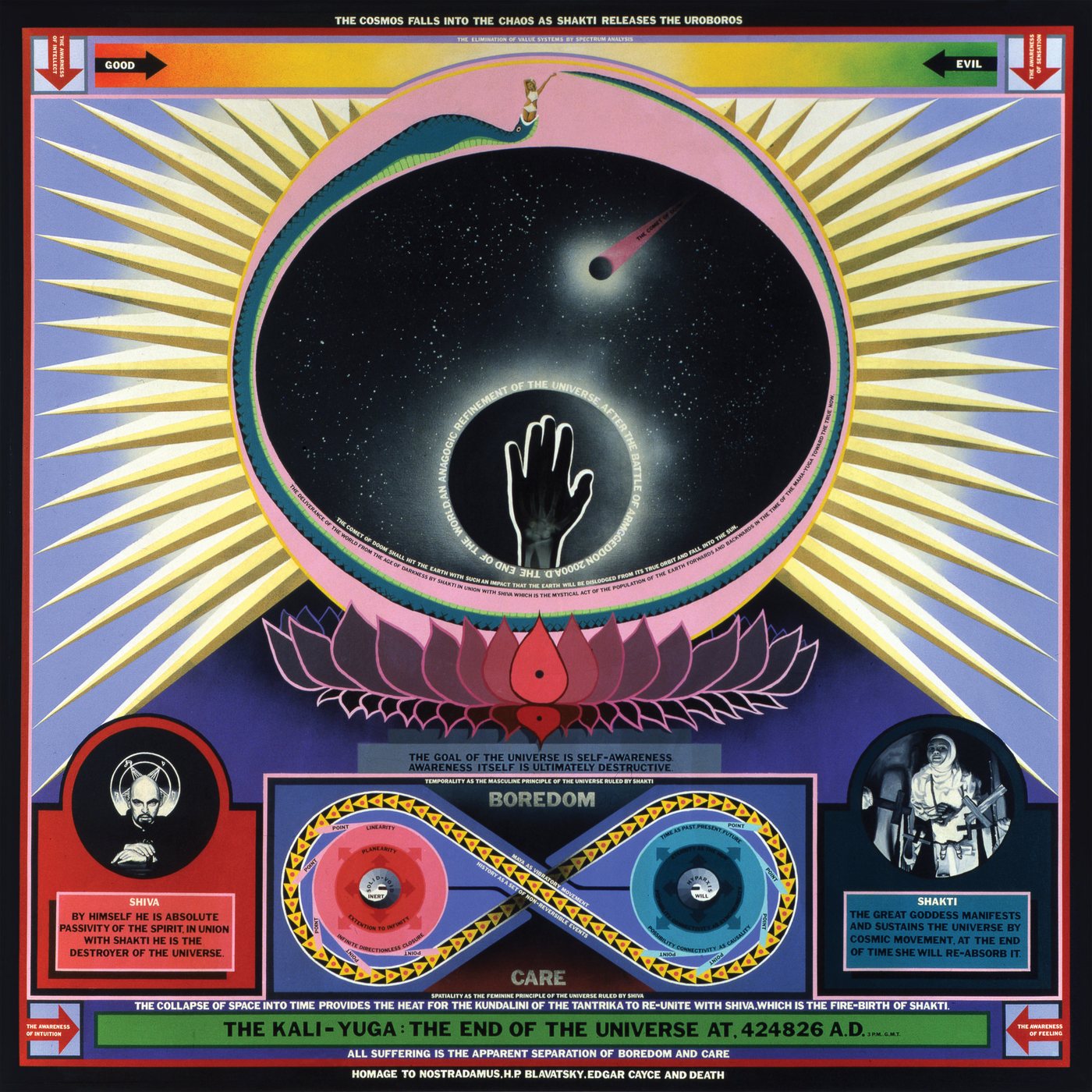
Back in Boston, Laffoley painted on weekends in the basement of his family's home in Belmont. There he finished what his estate calls his first fully mature work, The Kali-Yuga: The End of the Universe at 424826 A.D. (1965). Its format, a square mandala-like field of image and text, became the template for the next fifty years.
His gallery dates the founding of the Boston Visionary Cell to 1971 (the Outsider Art Fair says 1968). It was at once his studio, a registered organization and a circle of collaborators that organized shows and lectures around Boston. According to his dealer, the FBI questioned him because of the word "Cell" in the name. Physically it was an 18 by 30 foot room, where he worked for the rest of his life and produced, by one count, more than 800 works.
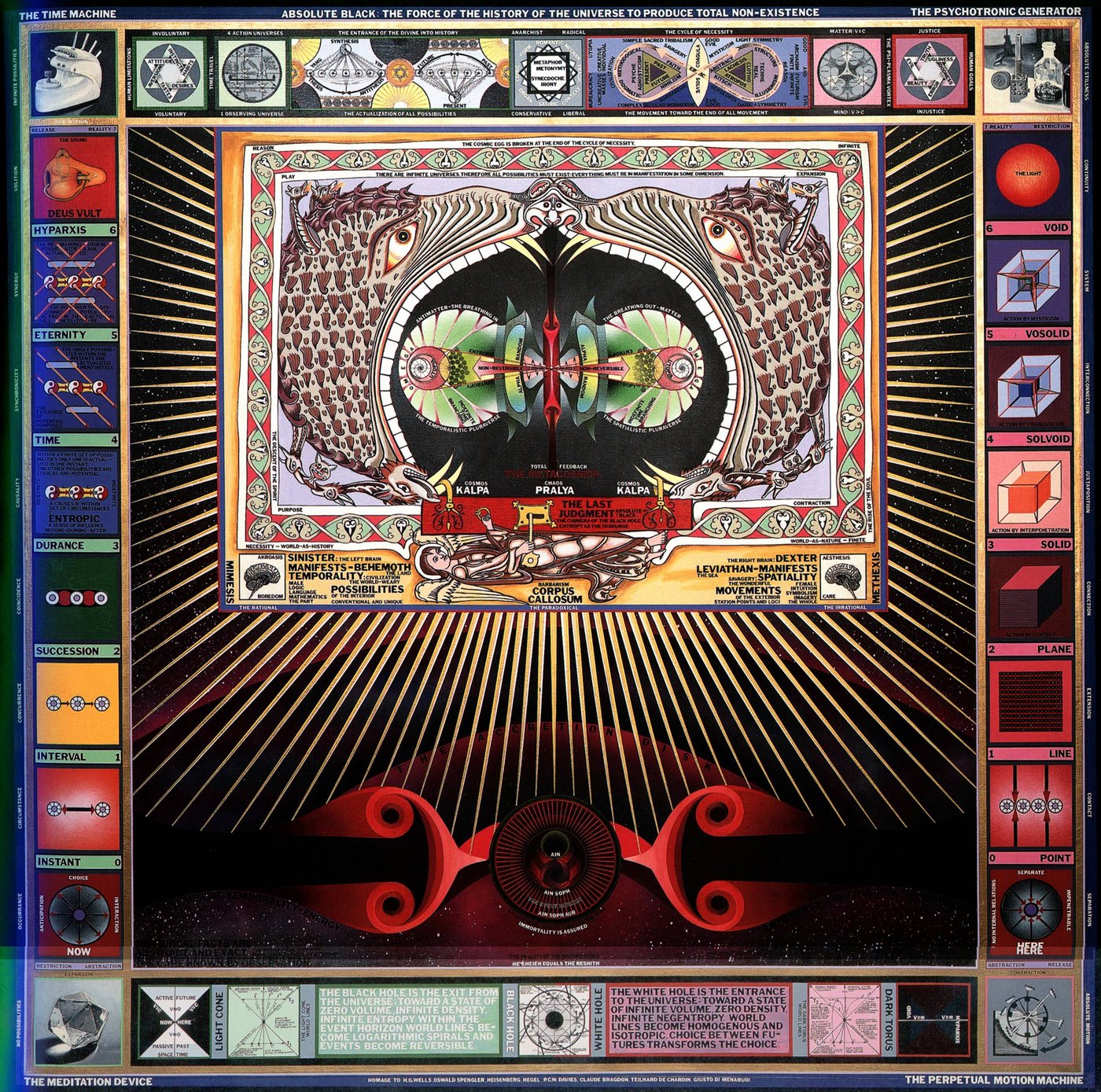
Laffoley did not work in series. Each painting was conceived as what he called a "structured singularity," a self-contained schematic of an idea. Most of the major canvases are 73½ inches square, and each could take up to three years to plan, paint and letter. He set the text by hand in small vinyl press-type letters, which forces the viewer to stand close and read.
He sorted his work into five broad categories: operating systems, psychotronic devices, meta-energy, time travel and lucid dreaming. The "homage" lines show his sources. On The Kali-Yuga it reads "Homage to Nostradamus, H. P. Blavatsky, Edgar Cayce and death." Elsewhere he salutes Plato, Goethe, Hegel, Gurdjieff, Ouspensky, Rudolf Steiner, Teilhard de Chardin, H. G. Wells and the fourth-dimension theorists Charles Howard Hinton and Claude Bragdon. He called Teilhard the Cell's "spiritual mentor."
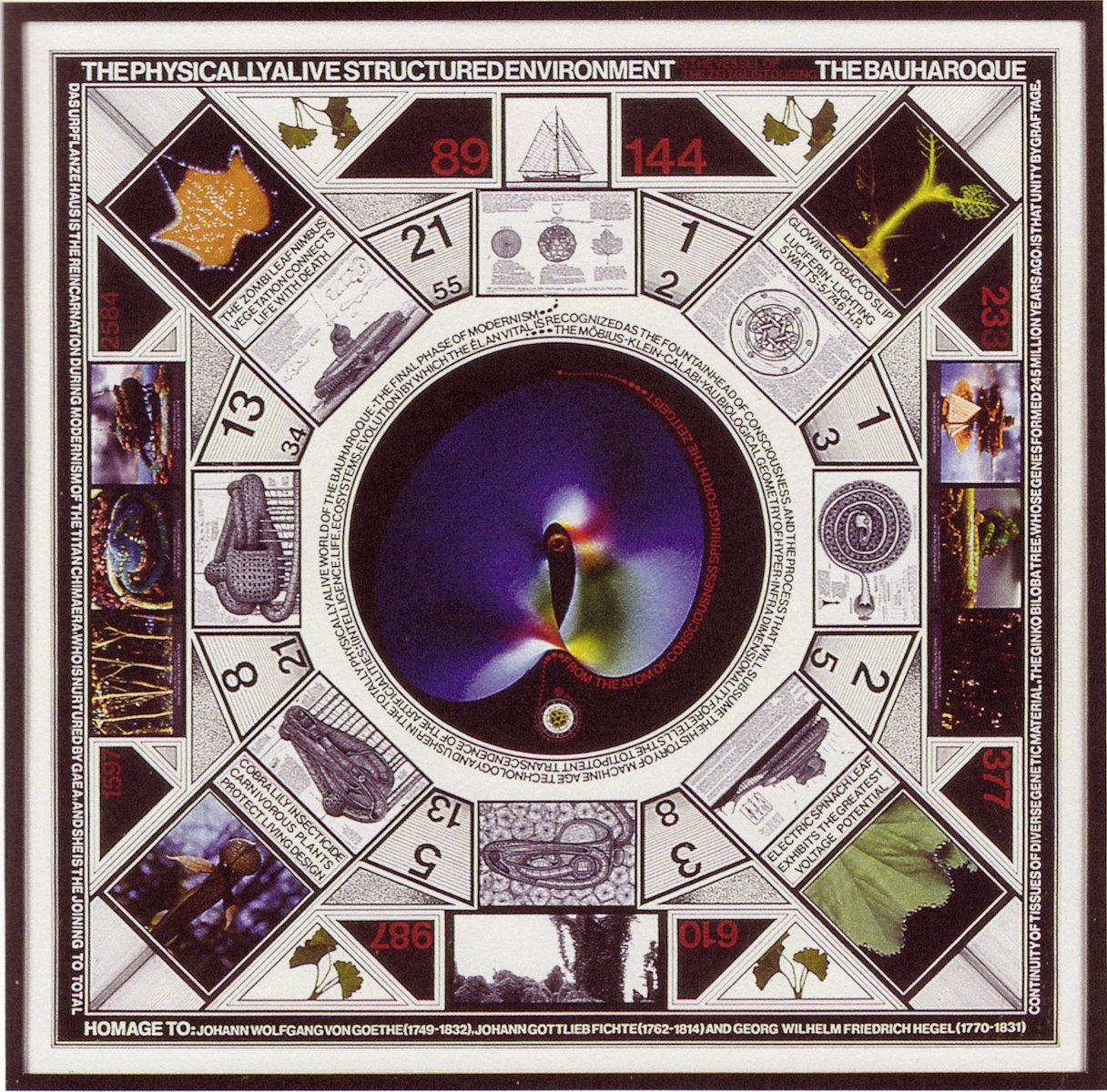
Laffoley's word for the age he believed was coming was the Bauharoque. "It's a combination of the Bauhaus and the Baroque," he told an interviewer in 2009: the engineering and functional discipline of modernism fused with the theatrical, organic excess of the seventeenth century. He first placed its start at 2000, then revised it to September 11, 2001. The idea runs through his architectural proposals, which imagined buildings that were grown and alive rather than built. They included the model Das Urpflanze Haus, and After Gaudí: A Grand Hotel for New York City (2002), which he submitted to the competition to rebuild the World Trade Center site.
He showed the idea under the titles Building the Bauharoque (Kent Gallery, 1995 and 1998) and Premonitions of the Bauharoque (Henry Art Gallery, Seattle, 2013). In 2009 he received a Guggenheim Fellowship, which he planned to spend on a series of paintings about it.
| Title | Year | Note |
|---|---|---|
| The City Changes Your Life | 1962 | Early panel showing a plane approaching the southern end of Manhattan |
| The Kali-Yuga: The End of the Universe at 424826 A.D. | 1965 | His first mature work |
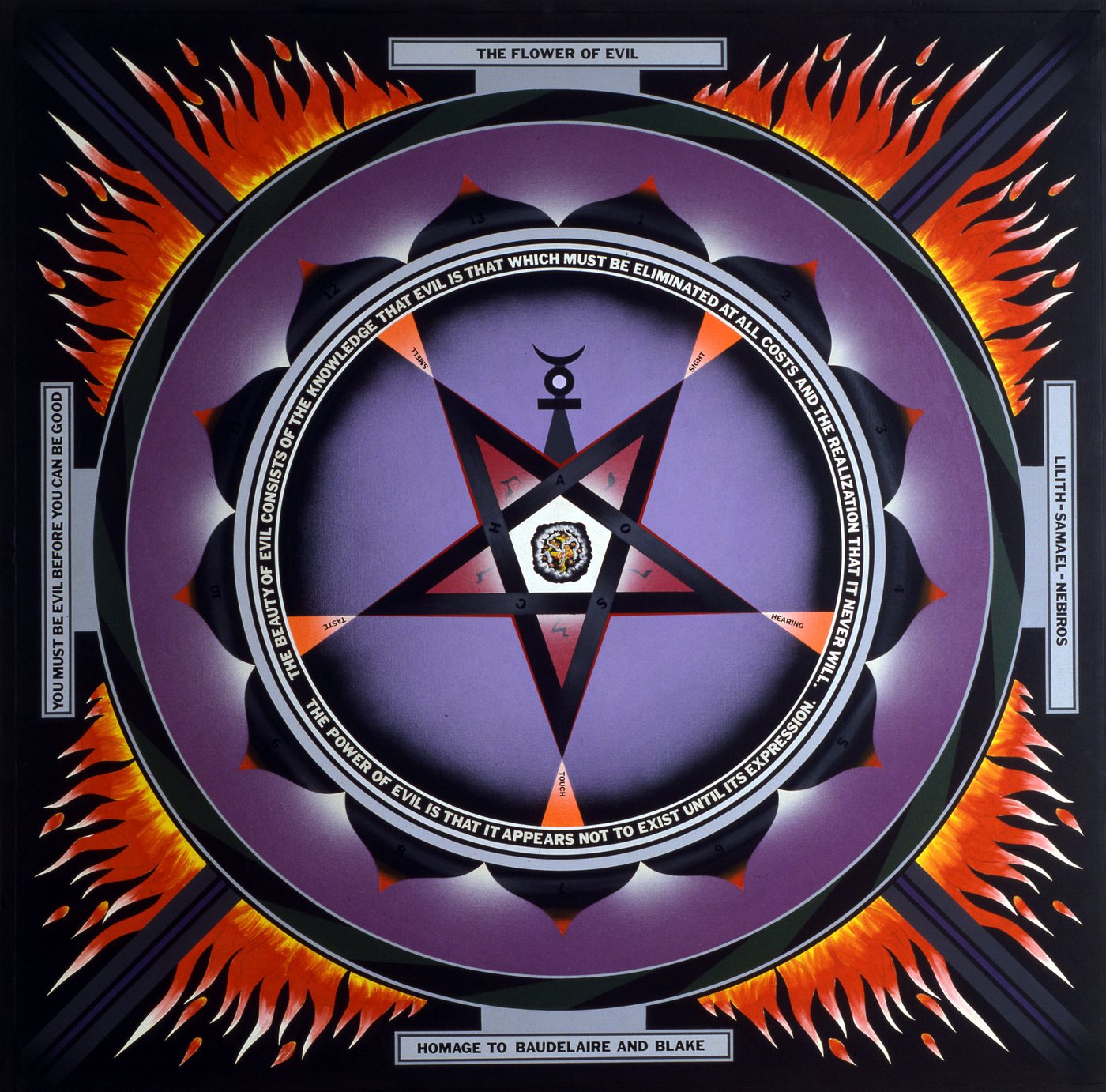
| The Flower of Evil | 1971 | "Homage to Baudelaire and Blake" |
| Alchemy: The Telenomic Process of the Universe | 1973 | The gallery's key alchemical canvas |
| The Living Klein Bottle House of Time | 1978 | Oil, acrylic and lettering on canvas |
| The Orgone Motor | 1981 | After Wilhelm Reich's orgone theory |
| Thanaton III | 1989 | His best-known "psychotronic device" |
| Geochronmechane: The Time Machine from the Earth | 1990 | A design for a time machine |
| The Solitron | 1997 | |
| Pickman's Mephitic Models | 2004 | After H. P. Lovecraft |
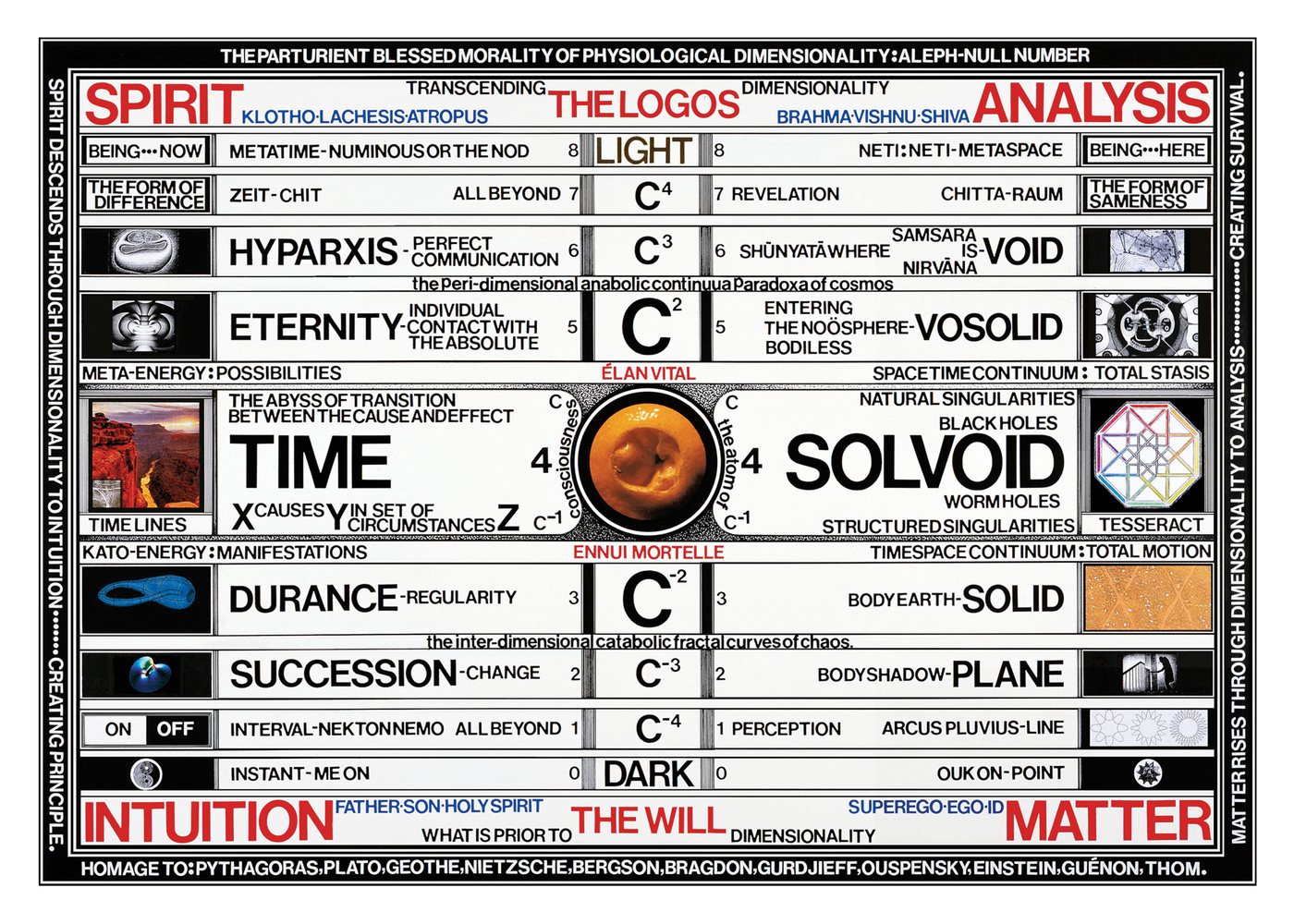
| The Parturient Blessed Morality of Physiological Dimensionality: Aleph-Null Number | 2004 to 2006 | Also issued as a print |
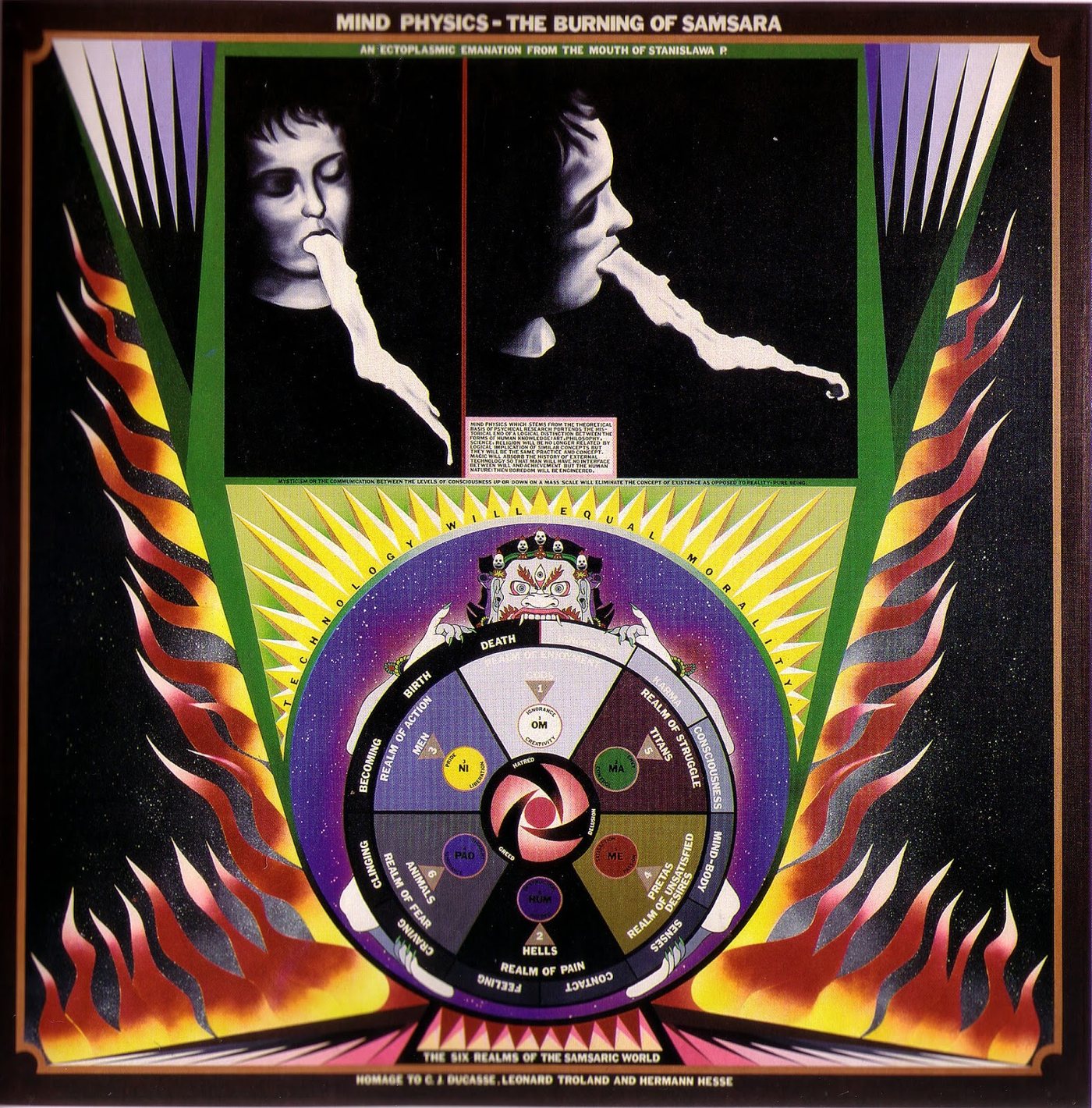
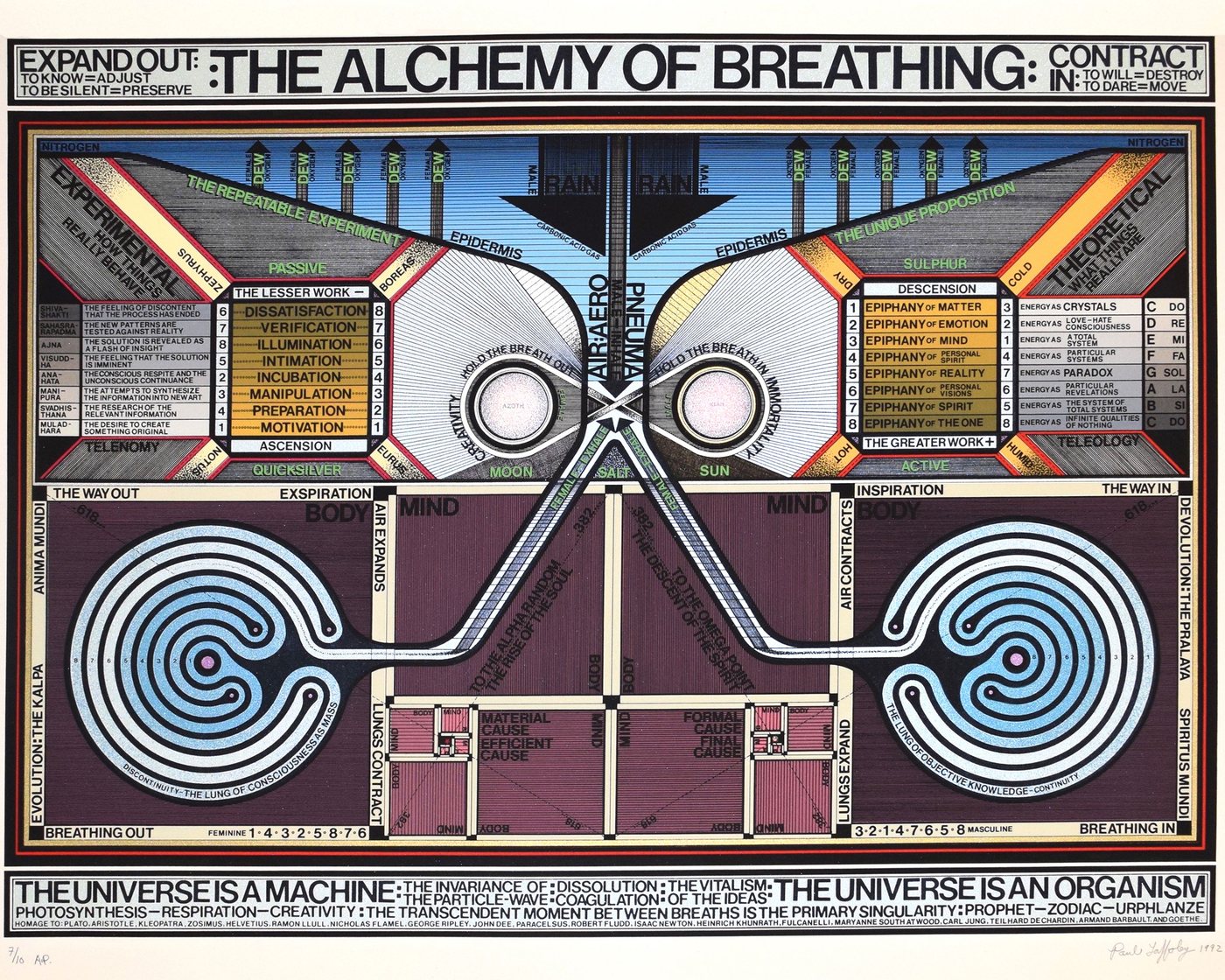
Two more titles in the archive's collection are documented but undated in the sources we could check. Mind Physics: The Burning of Samsara pairs painted images of the medium Stanislawa P. producing "ectoplasm" with a Tibetan wheel of life. The Alchemy of Breathing is a diagram of the breath as an alchemical process; the impression in our collection is signed and dated 1992 in the margin.
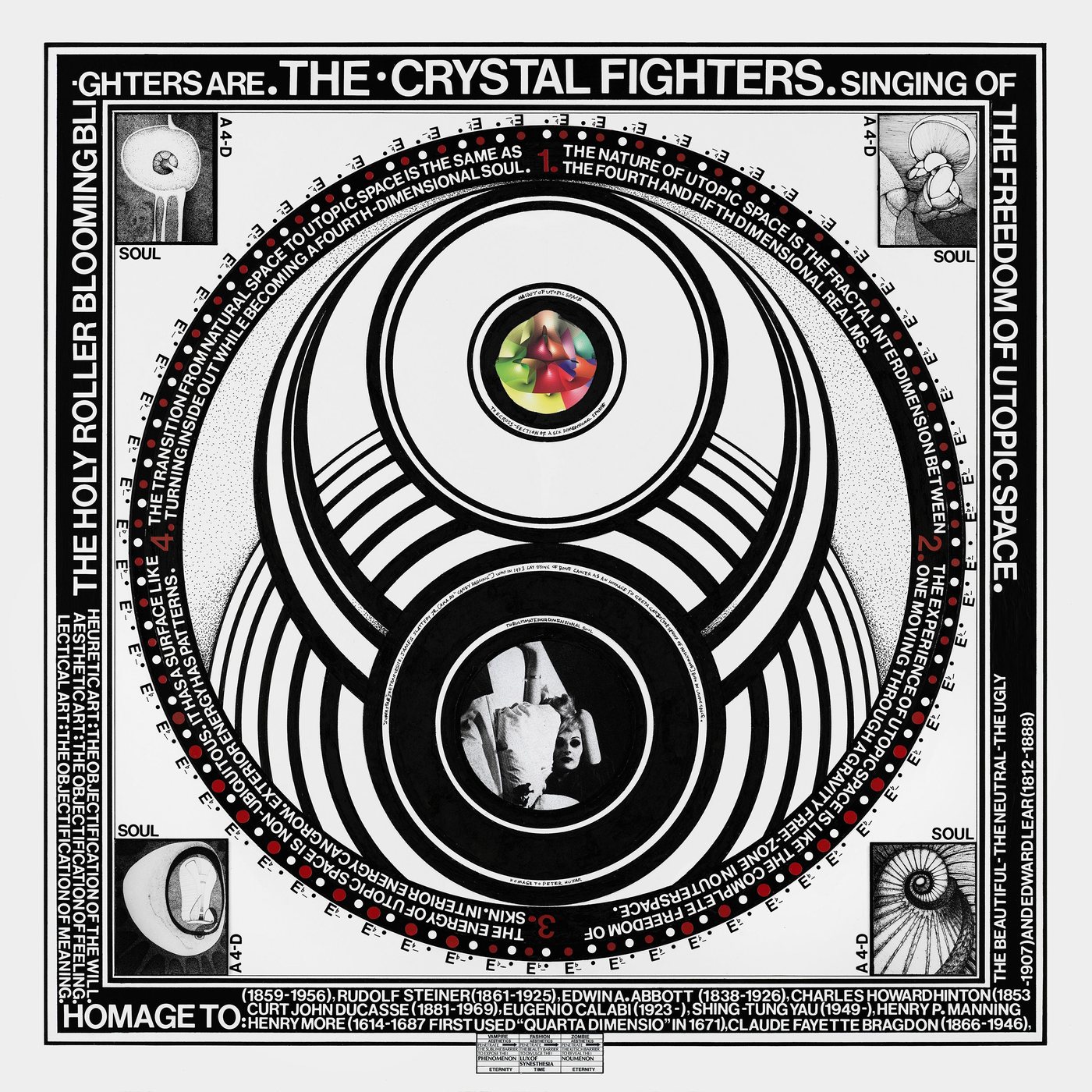
In 2013 Laffoley also made the cover art for Cave Rave, the second album by the band Crystal Fighters. The band's name is worked into the lettering around its border.
Laffoley's biography is inseparable from his claims, and he made them in the same calm, scholarly register as everything else.
Thanaton III. Laffoley wrote that on December 31, 1988, at 10:37 p.m., while giving a talk on the sidewalk outside 500 Boylston Street in Boston, he was visited by an alien named Quazgaa Klaatu, who "manifested as body of light." The being taught him how to link life and death and to use the resulting "thanatonic energy" to travel faster than light, and showed him how to make a painting that would pass the knowledge on. The result was Thanaton III (1989). A viewer is meant to use it by "touching the upright hands, and staring into the eye." The name Klaatu belongs to the alien visitor in the 1951 film The Day the Earth Stood Still, which Laffoley claimed to have seen 873 times.
The implant. He said that in 1992 a routine CAT scan before oral surgery showed a small metallic object in his brain, near the pineal gland. After consulting a local UFO group, he concluded that it was extraterrestrial in origin and "the main motivation of my ideas and theories."
The time machine. Laffoley held that the time machine was the one idea of science fiction that had never become fact. Geochronmechane was his proposed method, rooted in what he called "mind physics." He also published "The Time Machine from the Earth: Homage to H. G. Wells" in 1990. He presented it as a design, not as a machine he had built.
The prophecy. Late in life he said The City Changes Your Life (1962), which shows a small violet plane growing huge as it nears the tip of Manhattan, had foreseen the attacks of September 11, 2001. He attributed it to a dream he had the night before he left for New York, brought on by anxiety over leaving Harvard. As he himself noted, the dating of the painting rests on his word and its provenance.
Other contacts. He also said he had communicated with spirits, Nikola Tesla most notably.
Few of these can be tested, and none has been. A 2021 review in an academic journal observed that no reader "could be faulted for wondering if he invented some of his experiences." It is equally possible to take him at his word that this is what he experienced, and still treat the paintings as the thing that matters.
In 2001 Laffoley fell in his studio. Complications of diabetes followed, and his leg was amputated below the knee. The special-effects artist Stan Winston, known for Jurassic Park and Terminator, made him a prosthesis shaped like a lion's paw, a nod to his sign, Leo. Accounts disagree on which leg it was.
The Phenomenology of Revelation (1989), edited by Jeanne Marie Wasilik and published by Kent Fine Art, is an early monograph on his work, and it carries his own account of his life, including the electroshock treatments he said he received while at Brown. He was represented by Kent Fine Art (earlier Kent Gallery) in New York from 1987. Its director, Douglas Walla, became executor of his estate.
For decades Laffoley showed mainly in small Boston venues, with occasional reviews in the New York Times. The turn came in 1999, when the Austin Museum of Art organized the first survey of his career, Architectonic Thought-Forms. After that he gained a following among curators. The Palais de Tokyo in Paris gave him a room in Chasing Napoleon (2009). The Hamburger Bahnhof in Berlin showed his work in Secret Universe (2011), and the Hayward Gallery in London included Thanaton III in The Alternative Guide to the Universe (2013). His last solo show in his lifetime, The Force Structure of the Mystical Experience, closed at Kent Fine Art in November 2015.
Reviewing that show, the critic Tyler Coburn argued that Laffoley's learning was "too vast and scholarly for easy categorization" as outsider art, while noting that he benefited from the market for it. Coburn singled out The Meditron (1985), a shadow box made to communicate with his dead mother, as the most poignant work in the room.
Laffoley died of congestive heart failure at his home in Boston on November 16, 2015. The New York Times headline called him a "Painter Inspired by Time Travel and Aliens."
His reputation has grown since his death.
His journals and manuscripts have gone to the Peabody Essex Museum's Phillips Library, and his paintings are in the Hirshhorn, the Museum of Fine Arts in Boston, the Henry Art Gallery and the American Visionary Art Museum, among others.
It is easy to file Laffoley under eccentric and move on. The paintings resist that. They are not raw outsider art. They are the work of a trained architect with a classical education, built on a deliberate system and annotated with a bibliography. Whether or not a being of light visited him on Boylston Street, he spent half a century trying to draw the shape of time, consciousness and the higher dimensions with the tools of an architect. His closing advice, written in 2012, sums him up: "And whatever you do, do not die. There is no percentage in being dead. You will miss out on what happens next."
No account needed. You'll post as Anonymous Coward, and that ID stays the same for you on this thread.