#newjust now
Anonymous Coward
Guest
Few rooms have attracted as much suspicion as the Masonic lodge room. It is closed to outsiders during meetings, it is full of symbols, and it is often called a temple. But the room itself is no secret. Grand Lodges publish guides to it, and several of the grandest Masonic buildings in the world run public tours. What follows is what the room contains, what Freemasons say it means, and where some popular readings of it go wrong.
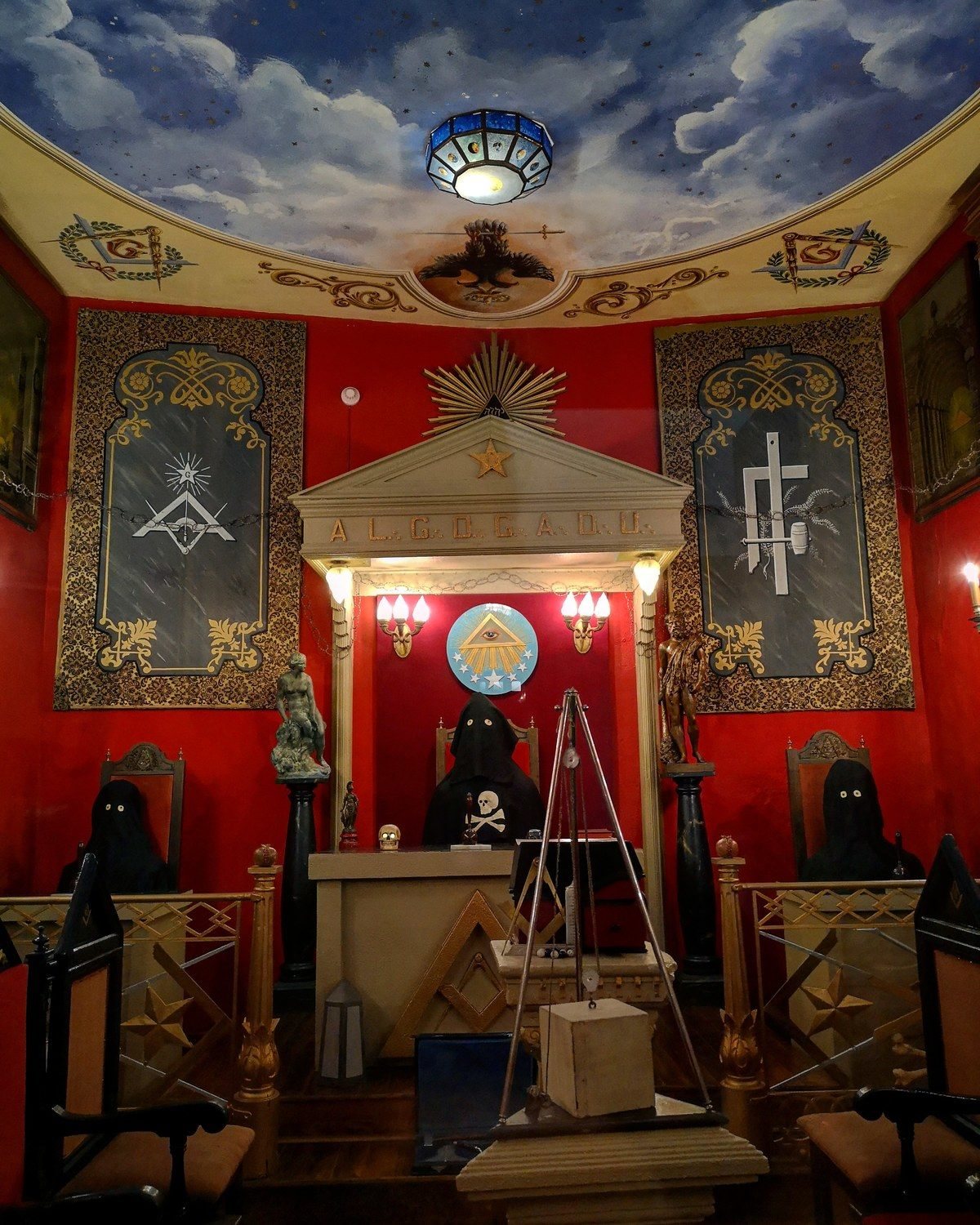
Start with the words. In Masonic ritual, a "lodge" is not a building. It is the body of Masons assembled to do their work. Once lodges had permanent halls, the word drifted onto the rooms and buildings where they met.
"Temple" followed a similar path. Masonic ritual is built around the story of King Solomon's Temple, and the lodge room is treated as a symbolic image of it. Over time "Masonic Temple" was also applied to the buildings themselves. In recent decades many jurisdictions have moved away from the word, because it suggests that Masons go to lodge to worship. Many lodges in New York, for example, now call their buildings Masonic centers.
Lodge rooms vary by country and jurisdiction, but most follow the same plan. It is oriented to the points of the compass, whatever direction the building actually faces.
| Position | Who sits there | Traditional explanation |
|---|---|---|
| East | The Worshipful Master, on a dais of three steps | The rising sun, which opens the day |
| West | The Senior Warden, on two steps | The setting sun, which closes the day |
| South | The Junior Warden, on one step | The sun at its meridian, at noon |
| Center | The altar | The place where the Volume of the Sacred Law lies open |
The North has no principal officer. In Masonic lecture it is the place of darkness, because the sun never stands there.
In American lodges the altar usually stands in the middle of the floor. In other parts of the world it may sit directly in front of the Master's chair, and some European lodges place the book on the Master's pedestal instead. Masonic historians note that early lodges sometimes sat around a table or in a triangle, and that the familiar eastward orientation settled in after the founding of the first Grand Lodge in 1717.
On the altar lies the Volume of the Sacred Law. In most English-speaking lodges this is the Bible, but a lodge may use the scripture of its members' faith. On the open book rest the square and compasses. Together the three are called the "three great lights" of Masonry. Three candles, often arranged in a triangle around the altar, are the "lesser lights" that illuminate them.
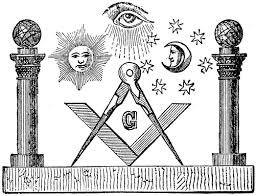
The checkerboard floor is the most recognizable feature of a lodge room. Masonic writers call it the mosaic pavement. With the "indented tessel" (a notched border around it) and the blazing star at its center, it forms the three "ornaments of the lodge." The Masonic scholar Shawn Eyer calls these three among the oldest symbols in Craft Freemasonry, well established from the early Grand Lodge era.
Masonic texts read them morally, not mystically. The 1868 Ahiman Rezon ties the black and white squares to human life "checkered with good and evil," the border to the blessings that surround us, and the star to divine providence. William Preston's older lectures read them differently, taking the star as the sun and the border as the planets. In other words, the meaning was never fixed.
Some lodges paint the whole floor as a pavement. Others lay a smaller checkered carpet around the altar. Masons also say the pavement recalls the floor of Solomon's Temple. That part is lore. The Bible's account of the Temple does not describe a checkered floor.
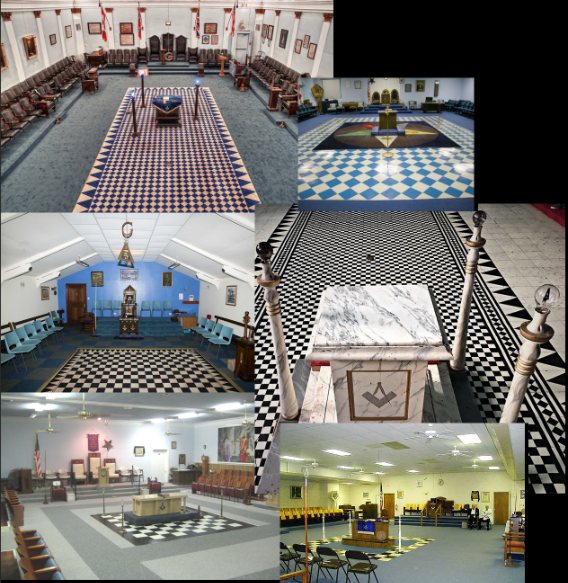
Two pillars stand near the entrance of most lodge rooms. Their source is the account of Solomon's Temple in the First Book of Kings, which describes a bronze worker named Hiram casting two great pillars for the Temple porch:
And he set up the pillars in the porch of the temple: and he set up the right pillar, and called the name thereof Jachin: and he set up the left pillar, and called the name thereof Boaz. And upon the top of the pillars was lily work: so was the work of the pillars finished.
1 Kings 7:21-22 (King James Version)
The same chapter gives their size as eighteen cubits high and twelve cubits around (verse 15). In lodge rooms they are often topped with globes. They mark the threshold the candidate passes through, which is why they so often frame the doorway or the West end of the room.
The letter G hangs above the Master's chair in many American lodges, or at the center of the blazing star. Masons give it two readings: God, whom they call the Great Architect of the Universe, and Geometry, which old Masonic texts treat as the foundation of the builder's art. Eyer cites an early record that places a G inside a blazing star and links it to geometry as a science that officers and apprentices should pursue. No single official meaning is binding on every Grand Lodge.
This is where the popular story goes furthest astray. The eye in a triangle is often called the Masonic eye, and its presence on the United States one-dollar bill is often taken as proof of Masonic design. The record points the other way.
The eye surrounded by a triangle is a Christian image of the Trinity and of Providence. Jacopo Pontormo painted one above three faces in his Supper at Emmaus of 1525. The eye was first proposed for the Great Seal of the United States by the first design committee in 1776, apparently at the suggestion of its artistic consultant, Pierre Eugène du Simitière, who was not a Mason. It was adopted on the reverse of the Seal, over an unfinished pyramid, in 1782. Benjamin Franklin was the only Mason on any of the Seal committees, and his own design suggestions were rejected.
The first official Masonic use and definition of the All-Seeing Eye is generally dated to Thomas Smith Webb's Freemason's Monitor of 1797, about fourteen years after the Seal was finished. The eye had appeared in Masonic decoration before that, but it was a borrowed Christian symbol in both cases. The Seal's reverse was put on the dollar bill in 1935.
In the early eighteenth century, lodges usually met in taverns. The symbols for the night's degree were chalked or drawn on the floor and wiped away after the meeting. By the late 1700s painted floor cloths had replaced the chalk. One surviving example, from the Lodge of Hope around 1780, is held by the Museum of Freemasonry in London. Eventually the images moved onto portable painted panels known as tracing boards, one for each of the three degrees, used as visual aids for lectures.
The most influential designer was John Harris, a designer and printer whose sets date from 1820 onward. His designs won the Emulation Lodge of Improvement's competition in 1845, and his revised boards of 1849 became the standard pattern across much of British and Commonwealth Freemasonry. If you have seen a tracing board with pillars, a pavement, a ladder and a starry sky, you have probably seen one descended from Harris.
As American and British lodges grew richer in the nineteenth century, they began building halls with several lodge rooms under one roof, each decorated in a different historical style. Egyptian rooms were the most dramatic. The fashion for Egyptian design had swept Europe after Napoleon's invasion of Egypt in 1798 and the publication of the Description de l'Égypte from 1809, and architects copied its plates, especially the temple facade at Dendera. Freemasonry, with its claims to ancient wisdom, was a natural home for the style. But Egyptian rooms sat beside Gothic, Moorish, Greek and Renaissance ones. The point was to show the craft's place in the whole history of building, not to claim descent from any one civilization.
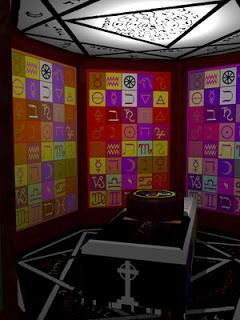
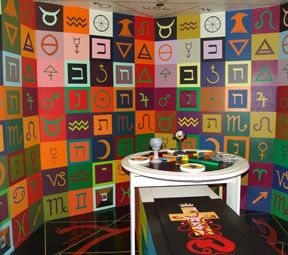
Many smaller lodges also painted their rooms with zodiacs, alchemical signs and symbolic figures. The photographs below come from the archive's collection and are said to show rooms in a Masonic temple. We have not been able to identify the building, so we make no claim about where they were taken.
| Building | Completed | Architect | Notes |
|---|---|---|---|
| Masonic Temple, Philadelphia | 1873 | James H. Windrim (exterior); George Herzog (interiors) | Grand Lodge of Pennsylvania; seven themed lodge halls |
| House of the Temple, Washington DC | 1915 | John Russell Pope | Scottish Rite, Southern Jurisdiction |
| Masonic Temple, Detroit | 1926 | George D. Mason | 1,037 rooms; largest Masonic temple in the world |
| George Washington Masonic National Memorial, Alexandria VA | Dedicated 1932 | Harvey Wiley Corbett | 333 feet tall; funded by American lodges |
| Freemasons' Hall, London | 1933 | H. V. Ashley and F. Winton Newman | United Grand Lodge of England |
The Grand Lodge of Pennsylvania laid the ten-ton cornerstone on St. John the Baptist's Day, June 24, 1868, and finished the building in 1873. James H. Windrim, who was 27 when he won the design competition, gave it a granite Norman exterior. The interiors came later and took decades. George Herzog, a decorative painter, began them in 1887, and the rooms were still being designed as late as 1908.
The building holds seven lodge halls: Egyptian, Oriental, Ionic, Corinthian, Norman, Gothic and Renaissance. Egyptian Hall was the first decorated and was dedicated in 1889. The Oriental Hall draws on the Alhambra in Granada. Corinthian Hall, in a Roman style, was finished in 1903. It is the clearest surviving example of the themed-room tradition, and it is open for public tours.
The headquarters of the Scottish Rite, Southern Jurisdiction, stands on 16th Street NW, about a mile north of the White House. John Russell Pope, later the architect of the Jefferson Memorial and the National Archives, modeled it on the Mausoleum at Halicarnassus, one of the Seven Wonders of the ancient world. Ground was broken on May 31, 1911, and the building was dedicated on October 18, 1915. Ionic columns 33 feet tall surround the Temple Room. Sources disagree on whether there are 33 or 36 of them.
Two sphinxes by the sculptor Adolph Alexander Weinman guard the entrance. According to the Scottish Rite, the one with open eyes is Power and carries the Hebrew name Boaz, and the one with half-closed eyes is Wisdom and carries the name Jachin. The two pillars of the lodge room, in other words, reappear here as two guardians. Albert Pike's remains were moved to the building in 1944, and Dan Brown set key scenes of The Lost Symbol (2009) there.
Ground was broken on Thanksgiving Day 1920. The cornerstone was laid on September 19, 1922, with the trowel George Washington used on the cornerstone of the US Capitol. The building opened on February 22, 1926, Washington's birthday, and was dedicated that Thanksgiving. George D. Mason designed it in a neo-Gothic style in Indiana limestone. It has 1,037 rooms and a main theater seating 4,635. It has been the largest Masonic temple in the world since 1939, when the Chicago Masonic Temple was demolished.
Washington had been Master of Alexandria Lodge No. 22, and American Masons built this memorial to him on a hill above the town. Every lodge in the country was asked to contribute. Harvey Wiley Corbett designed the 333-foot tower in stages modeled on an ancient lighthouse. Sources differ on whether the model was the Pharos of Alexandria or the lighthouse at Ostia. It was meant to open on the bicentennial of Washington's birth, but it was not ready, and it was dedicated on May 12, 1932, with President Hoover and most of his Cabinet present. The interior was not completed until 1970. It became a National Historic Landmark in 2015.
Masons have met on this site in Great Queen Street since 1775. The present building, the third, was built between 1927 and 1933 as a memorial to the 3,225 Freemasons who died on active service in the First World War, and was first called the Masonic Peace Memorial. It was renamed Freemasons' Hall at the outbreak of the Second World War. Its architects, Henry Victor Ashley and F. Winton Newman, won it in competition. The Grand Temple, seating 1,700, is entered through bronze doors by Walter Gilbert that weigh about one and a quarter tonnes each. Its mosaic ceiling shows the four cardinal virtues in its corners. It is the headquarters of the United Grand Lodge of England and houses the Museum of Freemasonry.
The lodge room is a stage for a moral drama, and almost everything in it is explained in ritual as a lesson about conduct: the square for virtue, the compasses for restraint, the pavement for the mixed fortunes of life. That does not make the symbols empty, and many Masons take them seriously as spiritual teaching. But it does mean that the most sinister readings depend on ignoring what Masons themselves say the symbols mean.
The buildings tell a second story. In barely sixty years, between Philadelphia and London, a fraternity that began in taverns built temples on the scale of state capitols. Whatever one thinks of the ritual, that ambition is visible in stone.
No account needed. You'll post as Anonymous Coward, and that ID stays the same for you on this thread.