#newjust now
Anonymous Coward
Guest
For 42 years a cluster of granite slabs stood in a pasture in Elbert County, Georgia, about seven miles north of the town of Elberton. Its opening line called for a world population "under 500,000,000." Nobody knew for certain who had paid for it. Before dawn on July 6, 2022, someone set off a bomb at the site, and by evening the county had knocked down what was left.
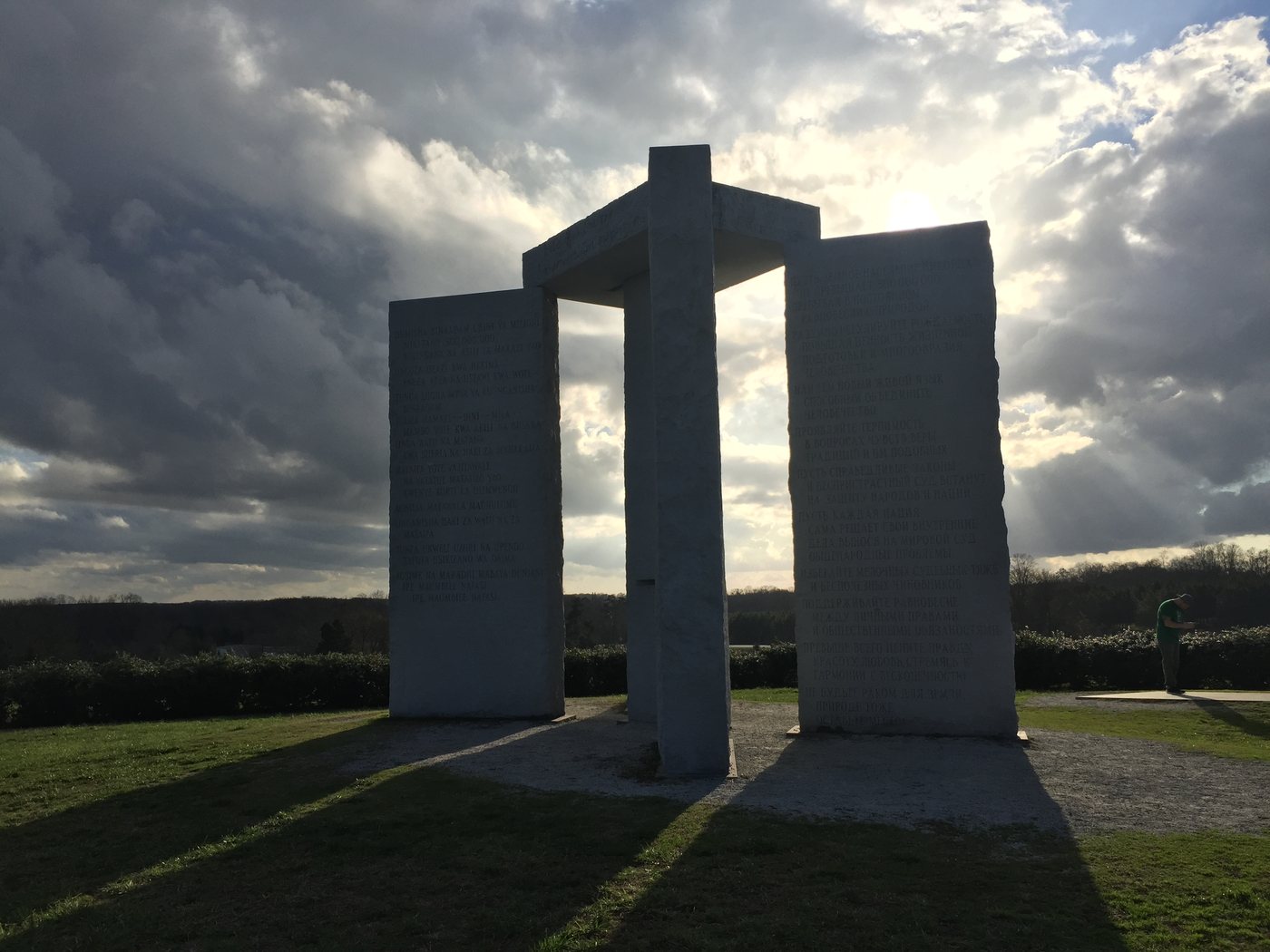
The photograph above was taken by the author of this site on a visit before 2022.
In June 1979 a well-dressed man walked into the offices of the Elberton Granite Finishing Company and introduced himself as Robert C. Christian. He admitted the name was a pseudonym. He said he represented "a small group of loyal Americans living outside of Georgia who wished to remain anonymous forever," and he wanted a monument built.
The company's president, Joe H. Fendley Sr., reportedly gave him a deliberately high quote, which Christian accepted. Fendley put him in touch with Wyatt C. Martin, president of Granite City Bank, who handled the money and acted as go-between. Martin learned Christian's real name and, by every account, vowed to keep it secret. The county took ownership of a five-acre plot for the site.
The monument was built from local blue granite and unveiled on March 22, 1980, by Congressman Doug Barnard.
The name invited speculation from the start. Several writers have pointed to Christian Rosenkreutz, the legendary founder of the Rosicrucians. That is a reading of the pseudonym, not a fact about its author.
| Feature | Detail |
|---|---|
| Overall height | 19 feet 3 inches |
| Total weight | About 119 tons (237,746 lb) |
| Main slabs | Four, each over 16 feet tall and 42,137 lb |
| Center | A gnomon stone, with a capstone across the top |
| Inscriptions | More than 4,000 sandblasted characters |
The monument was also an instrument. A slot through the center stone lined up with the sunrise at the solstices and equinoxes. A hole drilled at an angle through it framed the North Star. A small opening in the capstone let a beam of sunlight fall on the center stone at noon each day, so it worked as a sundial. The Georgia Encyclopedia adds that the outer slabs were aligned to the limits of the moon's yearly migration.
The four main slabs carried the same ten guides in eight modern languages: English, Spanish, Swahili, Hindi, Hebrew, Arabic, Traditional Chinese and Russian. The English text read:
1. Maintain humanity under 500,000,000 in perpetual balance with nature.
The Georgia Guidestones, English face (1980)
2. Guide reproduction wisely - improving fitness and diversity.
3. Unite humanity with a living new language.
4. Rule passion - faith - tradition - and all things with tempered reason.
5. Protect people and nations with fair laws and just courts.
6. Let all nations rule internally resolving external disputes in a world court.
7. Avoid petty laws and useless officials.
8. Balance personal rights with social duties.
9. Prize truth - beauty - love - seeking harmony with the infinite.
10. Be not a cancer on the earth - Leave room for nature - Leave room for nature.
The repeated "Leave room for nature" is on the stone. Around the capstone ran a shorter message in four ancient scripts: Babylonian cuneiform, classical Greek, Sanskrit and Egyptian hieroglyphs. It read "Let these be guidestones to an Age of Reason."
A flat tablet set in the ground nearby explained the monument. It named the author as "R. C. Christian" and the sponsors as "A small group of Americans who seek the Age of Reason." It gave the astronomical features and pointed visitors to the Elberton Granite Museum for more information.
It also mentioned a time capsule, with spaces for the dates when it was placed and when it should be opened. Those spaces were never filled in. In July 2022, after the bombing, officials dug six feet below the tablet and found nothing.
For decades the answer was simply unknown. Christian kept writing to Wyatt Martin for years after the unveiling. In a 2009 Wired feature, "American Stonehenge: Monumental Instructions for the Post-Apocalypse," the writer Randall Sullivan interviewed Martin, then the only living person known to have met Christian. Martin still would not give the name.
Christian did leave a paper trail of ideas. A book titled Common Sense Renewed, published under the name Robert Christian years after the monument went up, argued for population control.
The most serious attempt at an identification came from the CNN reporter Thomas Lake, published in February 2024. Lake drew on footage from the documentary Dark Clouds Over Elberton, in which the banker had shown the filmmaker documents from his files. A return address and postmark on one envelope pointed to Fort Dodge, Iowa. Lake identified Christian as Herbert H. Kersten, a Fort Dodge physician born in 1920, who died in 2005. In a 1998 letter Christian had given his age as 78, which matched Kersten's. Kersten's published letters, which often warned about overpopulation, read much like Christian's.
The case is circumstantial. When Lake phoned Kersten's son, the son said he was not familiar with any connection, and Lake could not verify some of the claims about Kersten's associations. It is the strongest candidate anyone has named, but it is not proof.
A monument that called for a population of half a billion, a world court and a "living new language" was bound to alarm people who already feared a planned world government. Over the years the Guidestones were called a New World Order manifesto, a blueprint for depopulation, and a satanic altar. The anonymity made it worse. A secret group with money and a plan for humanity was precisely what those theories predicted.
Others read the same text very differently. Yoko Ono called it "a stirring call to rational thinking." Sullivan's Wired headline caught the other reading: instructions for whoever was left after a catastrophe, not a plan to cause one.
The vandalism started long before the bomb. In 2008 the stones were spray-painted with slogans including "Death to the New World Order." In September 2014 someone painted "I Am Isis, goddess of love," and a county employee contacted the FBI. In May 2022 Kandiss Taylor, running in Georgia's Republican primary for governor, called the Guidestones "satanic" in a campaign ad and promised to tear them down if elected. She lost the primary.
According to the Georgia Bureau of Investigation, "unknown individuals detonated an explosive device" at the site at about 4:00 a.m. The blast destroyed one of the four main slabs and damaged the capstone. No one was hurt. The GBI released surveillance video showing the explosion and a car leaving the scene shortly afterward, and later footage of a person running to and from the monument.
Later the same day the rest of the structure was knocked down with heavy equipment. The GBI said it had been "completely demolished" for safety reasons. After the blast, Taylor wrote on Twitter: "That includes striking down Satanic Guidestones."
In August 2022 the county voted not to rebuild and to give the remains to the Elberton Granite Association, which runs the granite museum. Its executive vice president, Chris Kubas, said they had agreed "to take the stones in an effort to preserve them." The land went back to the family that had originally owned it, under the terms of the deed, and was later sold.
In April 2026 the Atlanta Journal-Constitution, in its podcast series Who Blew Up the Guidestones?, reported that the broken stones were still in Elbert County, lying in a quarry scrapyard less than five miles from where they once stood. It also reported that the explosive was probably an easy-to-buy exploding target mixture such as Tannerite, not quarry dynamite, which was all accounted for, and that sharper analysis of the video suggested the getaway car was a 2006 to 2008 BMW sedan. The GBI confirmed it was treating a lead the podcast turned up as active. As of that report, no one had been arrested or charged.
The Guidestones end as they began: with two unknowns. We still do not know for certain who paid for them, though Herbert Kersten is now the leading candidate. And we do not know who destroyed them. The ten guides survive in photographs, in the museum's model, and in the many arguments they started. For a monument meant to speak to people after a catastrophe, it is an odd fate that its own destruction became the event it is best remembered for.
No account needed. You'll post as Anonymous Coward, and that ID stays the same for you on this thread.