#newjust now
Anonymous Coward
Guest
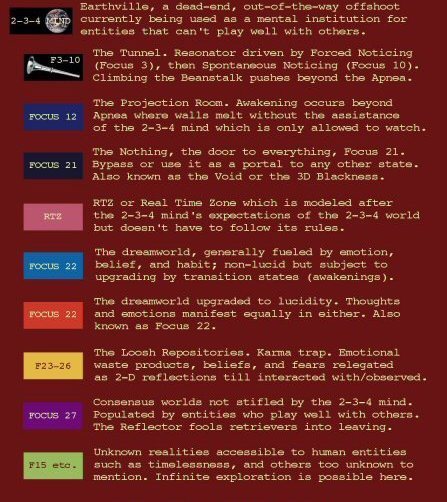
Robert Monroe did not come to out-of-body experiences through religion or the occult. He was a broadcasting businessman who, by his own account, began having them without wanting to, feared he was ill, and spent the rest of his life trying to understand them. His first book is credited with popularising the very phrase "out-of-body experience", his institute sold a method for inducing them, and in 1983 a US Army officer wrote a long assessment of that method. He is also the one person in these files who was tested directly, in a laboratory, by a sympathetic scientist.
Robert Allan Monroe was born in Indiana on 30 October 1915 and died on 17 March 1995. After Ohio State University he worked in radio, and in 1953 formed RAM Enterprises, which produced network radio programmes. In 1956 the company set up a research division to study the effect of sound patterns on consciousness, including sleep-learning.
In Journeys Out of the Body he dates the start to 1958: episodes of paralysis and "vibration", the first with a bright light, recurring over several weeks until he found himself separated from his body. He consulted his doctor, then a psychologist friend, and eventually found older writers on "astral projection". He avoided that term and coined his own: the "Second Body", the "Second State", and three "Locales" he believed he visited. Locale I was the ordinary physical world, here and now; Locales II and III were stranger places that could not be checked.
The early book is unusual in the genre because Monroe tried to sort his experiences by whether they could be verified, and said plainly how few could. Only visits to Locale I produced anything checkable:
Even so, these and others in the same category are pitifully few in proportion to all the recorded experiments.
Robert Monroe, Journeys Out of the Body (1971), chapter 4, "The Here-Now"
Elsewhere he puts the total at "some 589 experiments over a period of twelve years" (chapter 19, "Statistical Classification").
His best-known evidential case is in chapter 3, "On the Evidence". One Saturday afternoon he tried to visit a colleague, R. W., who was away for the weekend. He saw her in a kitchen with two teenage girls, one blonde and one dark, all drinking, and pinched her on the side to make sure she would remember. On the Tuesday she confirmed she had been in the kitchen of a beach cottage with her niece and the niece's friend, she with a drink and the girls with Cokes. When he asked about the pinch, she showed him the spot:
There were two brown and blue marks at exactly the spot where I had pinched her.
Robert Monroe, Journeys Out of the Body (1971), chapter 3, "On the Evidence"
He scored it himself, item by item, and marked the possibility of "autosuggestion hallucination" as "indeterminate". It remains a story told by one party to it, with no record made before the outcome was known.
The later books move beyond anything that could be checked. Far Journeys includes a parable, in chapter 12, "Hearsay Evidence", about a substance called Loosh that beings "Somewhere" value, and how "Someone" decided "to build a Garden and grow Loosh". It has since taken on a life of its own online as a literal claim that humans are farmed for their suffering. In the book it is presented as something told to him. Ultimate Journey closes on advice rather than evidence, starting with: "Always know and remember that you are 'more than your physical body.'" (chapter 7, "Tour Guide").
The psychologist Charles Tart met Monroe in the autumn of 1965, when Tart took a research post at the University of Virginia medical school. In his later summary, "Six Studies of Out-of-Body Experiences" (Journal of Near-Death Studies 17(2), 1998), Tart describes three studies with him.
Charlottesville, 1965 to 1966. Monroe came in for eight late-night sessions between December 1965 and August 1966 in the hospital's EEG laboratory, wired up and trying to read a target number. On the eighth night he reported two out-of-body episodes. In the second he went looking for the technician and found her in the outer room with a man he did not know. She told him it was her husband, who kept her company on late shifts and whom Monroe had never seen. But her own notes record that Monroe "did not see the number", and that "it is possible that Mr. Monroe may have heard the visitor cough during his [cigarette] break". Tart's verdict: "we have only weak evidence that Monroe was actually 'out' on this occasion, a result he found as unsatisfactory as I did."
The beacon test. After Tart moved to the University of California at Davis, he and his wife tried to "guide" Monroe across the country at a randomly chosen time without telling him when. Monroe reported being pulled out of his body within a minute or two of the start, and phoned at 11.05 pm California time. But his description of the house and what the Tarts were doing was, in Tart's words, "quite inaccurate", and Tart wrote: "Looking at the description, I would conclude that nothing psychic had happened."
Davis, 1968. On a visit to California, Monroe spent an afternoon in Tart's sleep laboratory, asked to travel to the equipment room and read a five-digit number. He reported two brief OBEs. In the second he found himself outside, facing the wall of another building, and later recognised a courtyard on the far side of the building from the equipment room, which he might have glimpsed from Tart's office earlier that day. He did not read the number. Tart's summary of all his work with Monroe: "no ESP results clear enough to be conclusive, but not results so clearly inaccurate that I would feel comfortable saying nothing at all happened."
Monroe's company moved to Virginia in 1962. By 1980 its research arm was operating as the Monroe Institute of Applied Sciences at Faber, Virginia, the name used in the Twemlow paper and in the 1983 Army report. Sources give different founding dates for the institute itself; the present nonprofit, The Monroe Institute, was separated from the company in 1985. It sits on several hundred acres south of Charlottesville.
Its central technology is Hemi-Sync, short for hemispheric synchronisation: tones of slightly different frequency played in each ear, producing a perceived "binaural beat" at the difference frequency, which Monroe held would lead the brain into particular states. His first related patent, US 3,884,218, "Method of inducing and maintaining various stages of sleep in the human being", was filed in 1970 and granted on 20 May 1975. The Gateway Experience, a graded series of exercises using numbered "Focus" levels (Focus 10, 12, 15, 21 and so on), was first run in 1977, with forty participants, and later sold on tape. In 1994 the Wall Street Journal reported confirmation from a former head of the Army's Intelligence and Security Command that personnel had been sent to the institute.
The document is "Analysis and Assessment of Gateway Process", dated 9 June 1983, from Lt. Col. Wayne M. McDonnell, Commander, Detachment O, US Army Operational Group, Intelligence and Security Command, Fort Meade, Maryland. It was approved for release on 10 September 2003 and sits in the CIA's reading room as CIA-RDP96-00788R001700210016-5. The CIA copy is missing page 25. We host a copy in the library: Analysis and Assessment of Gateway Process (PDF).
McDonnell was tasked with assessing Gateway "in terms of its mechanics and ultimate practicality". His cover memo explains that, to do so, he drew on Itzhak Bentov's biomedical models, holography and quantum physics, aiming "to bring the whole phenomenon of out-of-body states into the language of physical science to remove the stigma of its occult connotations". The body of the report builds a theory of consciousness as a holographic energy system able to move outside time and space, ending in a section on belief systems and "the Absolute", and a list of proposed experiments, including using three people at different Focus levels to view a target and comparing their reports.
Read for what it is, the report is a theoretical essay written to help Army personnel make sense of a training course, not a test of it. Its bibliography has nine entries: popular books such as Bentov's Stalking the Wild Pendulum, Monroe's Journeys Out of the Body, Tart's Altered States of Consciousness, a Mother Earth News article, and an undated monograph published by the Monroe Institute itself. It reports no controlled trials. Its fame comes from its letterhead, and from viral posts that treat "the CIA confirmed astral projection" as its conclusion, which it is not.
The fair reading is that binaural-beat audio can help some people relax and focus, which is consistent with a guided-meditation effect, while the claim that it synchronises the hemispheres or reliably drives the brain into specific states is not established. None of this research tests whether anyone leaves the body.
Monroe was candid, curious and, in his first book, more self-critical than most of his followers. His experiences were plainly real to him, and Tart's recordings show they arose in a drowsy, dream-like stage 1 sleep state. But in the only controlled tests of his perceptions, run by a friend who hoped they would succeed, he never read the target, and his most striking hit had an ordinary explanation noted at the time. The Army assessment is a theory built on his claims, not evidence for them. His evidential case rests on his own journal.
No account needed. You'll post as Anonymous Coward, and that ID stays the same for you on this thread.